1926-1939
The Golden Beginnings on Potsdamer Straße

Harry Lehmann
Harry Lehmann, born on October 11, 1898, opened the first store of the family business in March 1926 together with his father Eduard Lehmann. Harry Lehmann led the company from 1926 until his death in 1967, shaping it alongside his employees over many decades.
At that time, perfumeries in Germany and particularly in Berlin were not yet as common as they were in France. The idea of offering customers a touch of luxury through beautiful fragrances while pursuing entrepreneurial endeavors appealed to Harry Lehmann, who was only 27 years old at the time.

March 19, 1926
It was the era of the Roaring Twenties when HARRY LEHMANN first opened its doors. Berlin had become the "Babylon of the 1920s," a thriving world metropolis of 4 million inhabitants that was flourishing once again after the hyperinflation of 1923. The first store was located on Potsdamer Straße near Potsdamer Brücke - a perfectly chosen location in the heart of vibrant Berlin, just steps away from what was then Potsdamer Platz.

Perfume by Weight & Artificial Flowers
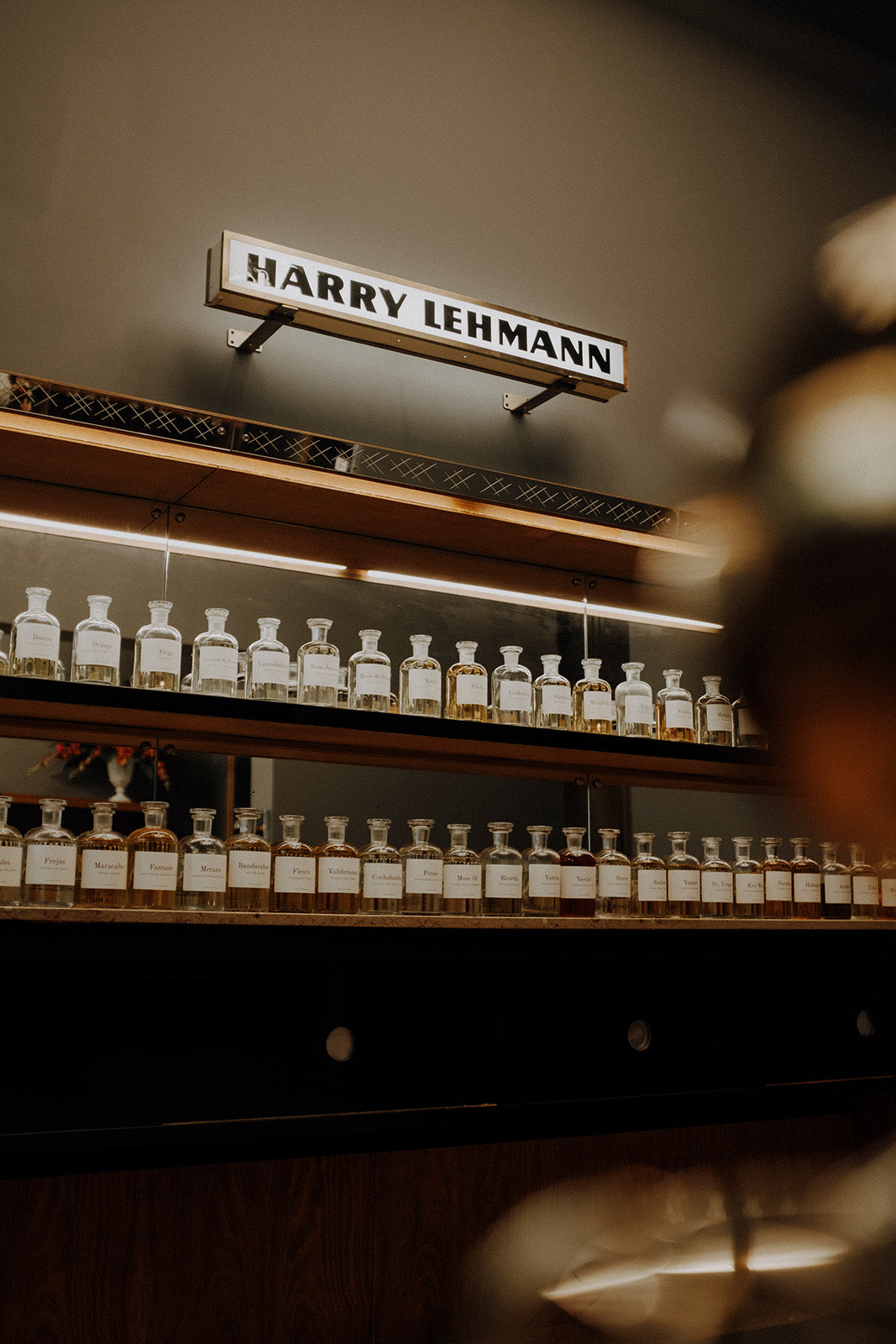
The concept was revolutionary: perfume sold by weight and artificial flowers. Customers could discover fragrances in the store and purchase them in their desired amount of grams, making fine fragrances accessible to everyone. Perfect for a city that desired luxury but needed to be frugal. The perfumes were meticulously weighed on a golden-gleaming scale that would become the hallmark of the house.

The artfully arranged silk flowers were decorative both in the store and at home, and could even be used as room fragrances by spraying them with a scent. With this concept, HARRY LEHMANN became the first store of its kind in Germany.

The store was opulent and furnished with meticulous attention to detail. Glass vitrines, large display windows, and mirrors. The numerous fragrances and artificial flowers transformed the store into a sensory experience that captured the curious gazes of passersby and made them slow their pace. This combination of scent and visual splendor quickly made HARRY LEHMANN a renowned destination for fine fragrances in and from Berlin. In this city, ecstasy and hedonism shaped everyday life - people danced the Charleston and experimented with fashion and sexuality.

From the very beginning, the store offered customers an extensive selection of approximately 30 carefully composed fragrances that captured the spirit of the late twenties. Lily of the Valley, Violet, and Red Poppy were among the first creations - floral, romantic, and crisp scents that perfectly matched the elegance of the Weimar Republic and were en vogue. Each fragrance was developed and produced in-house and bore the unmistakable signature of the Lehmann family.

The "Tropfer"
It was Harry Lehmann himself who invented the "Tropfer" (dropper) at that time. As early as 1926, an initial version of this metal and chrome invention hung on the exterior facade of the founding store, dispensing free drops of the scent of the day for sampling. Passersby could hold out their hand and let a drop fall onto it for testing. The dropper became a city-famous attraction that was later even extensively celebrated in the press. Passersby would stop, try the fragrances, and take in the scents. Many of them returned as customers.

Marlene Dietrich purchased "Violet" here.
During these golden years on Potsdamer Straße, HARRY LEHMANN established itself among Berlin's prominent figures, thanks to its prime location and opulent yet not ostentatious presentation. Marlene Dietrich, who was on the verge of becoming a star, was among the customers who purchased their fragrances at HARRY LEHMANN. "Der Blaue Engel" (The Blue Angel) was being filmed in the city, and Violet was the fragrance that Marlene Dietrich regularly bought here.

Yet the era of optimism was not to last forever. In 1933, Berlin transformed from Europe's most liberal city into the capital of dictatorship. The colorful diversity vanished, the city became gray, uniformed, controlled. In 1939, the era of this first store ended abruptly. The North-South Axis planned by the National Socialists in Berlin necessitated abandoning the business premises. It was the first of many relocations that the small family business would endure and survive.

1940-1951
War, Destruction, and New Beginnings

In search of new premises to continue operations, a location that was equally well situated was found. From 1940 to 1943, Harry Lehmann continued his business at Friedrichstraße 80, opposite the Kaisergalerie, just before Unter den Linden. Here, the cultural and commercial life of the Reich capital unfolded, right in Berlin's historic center. The relocation succeeded and the clientele followed.

But the war caught up with the perfumery: bombs completely destroyed the store. Harry Lehmann personally salvaged the last intact goods from the rubble. A scene that symbolized the family's unwavering determination to preserve their craft and never give up.

After an interruption during the war years of 1944/1945, when Berlin and especially the city center were marked by fierce battles and air raids, operations resumed in 1946 at yet another new address on Friedrichstraße at the corner of Mohrenstraße, where the modern Quartier 205 stands today. Back then, it was a location in the midst of the destroyed city center, where Trümmerfrauen cleared away the ruins and people tried to rebuild a sense of normalcy. The store opened in a ruin.
Just five years later, in 1951, the emerging East-West tensions of the divided city forced the Lehmann family to relocate their store once again. This time they moved to the western part of the city, to Joachimsthaler Straße opposite Bahnhof Zoo.

1952-1958
Branches at Bahnhof Zoo and on Wilmersdorfer Straße

Branch on Joachimsthaler Straße
In 1952, the Lehmann family opened a new store in what was now a divided Berlin. In a simple postwar building on Joachimsthaler Straße, diagonally across from Bahnhof Zoo and the Zoological Garden, they continued their business. Even in this store, they managed to offer an impressive shopping experience with opulent decoration and lavish presentation. The concept of perfume by weight and artificial flowers continued unchanged, enabling a small luxury in everyday life even during the economically difficult postwar years.

The "Tropfer" - Still Hanging Today at Kantstr. 106
For the store on Joachimsthaler Straße as well, where the Waldorf Astoria Hotel stands today, Harry Lehmann had a new dropper made, as the original dropper had not survived the war years. Unlike the postwar building, this very dropper still exists today and was put back into operation in 2025.

Due to the uncertain history of locations and economic success, another branch was opened in 1953 on Wilmersdorfer Straße, directly opposite what was then the HERTIE department store. At that time, Wilmersdorfer Straße was not yet a pedestrian zone but a busy street with streetcar line 3 running down the middle. In 1957, the branch on Wilmersdorfer Straße closed again. Just one year later, in 1958, space had to be made on Joachimsthaler Straße as well, necessitating yet another move and continuing the trail through the city.

1958 - 1969
Branches in Berlin and Germany

Kantstraße - A Home for Eternity
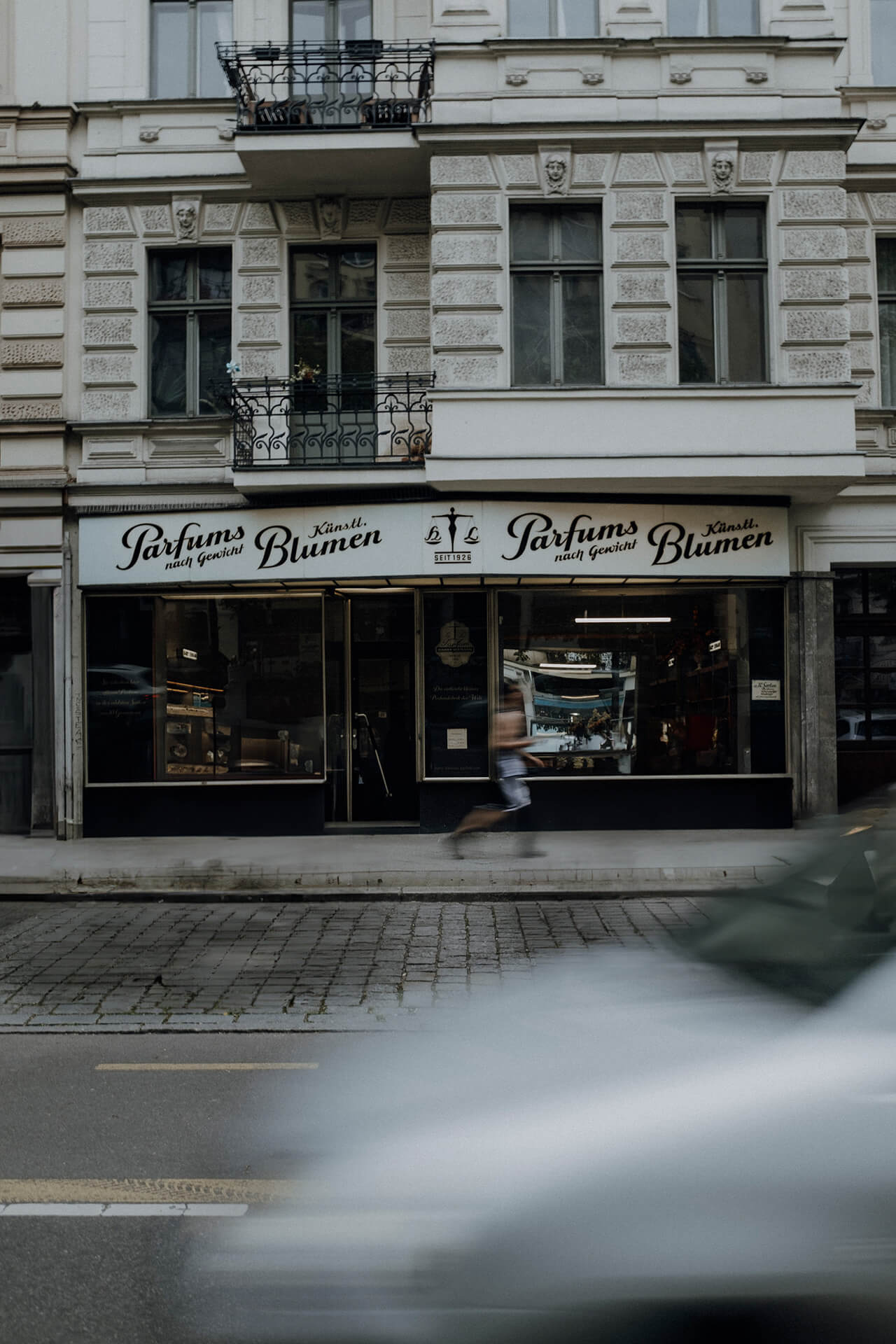
In that same year, 1958, HARRY LEHMANN finally found its new and enduring home at Kantstraße 106 in Berlin-Charlottenburg, close to the Wilmersdorfer Straße shopping mile. Initially it was just a small store, but two years later it doubled in capacity through the acquisition of the neighboring shop. Since 1958, the iconic illuminated sign has also reigned in front of the store - a small landmark that guides passersby to this day.

Here, in this very store, Jutta Dallmann's remarkable career at HARRY LEHMANN also began. The then 18-year-old woman started her position in 1958, fulfilling a long-cherished dream. During her apprenticeship, which she completed at a bakery, she always rode the bus past HARRY LEHMANN on Joachimsthaler Straße and sat upstairs on purpose to get a better view into the store. "That's where you want to work someday," she told herself. In 1958, this wish became reality. It was the beginning of a devoted passion that continues to this day.

Branch in Berlin Neukölln
The industrious and entrepreneurial Lehmann family learned from the past and also opened another branch in Berlin-Neukölln in 1958. The branch at Karl-Marx-Straße 146, which existed for 11 years from 1958 to 1969, was small at only 20 square meters but ideally equipped and well located. Situated directly between the two U-Bahn exits at U-Bhf. Karl-Marx-Straße on the U7 line, the store offered everything that the store on Kantstraße offered: a perfume counter with all varieties, the familiar apothecary scales, artificial flowers, and even artificial trees.

1967 - 2008
Harry Lehmann's Death and the Continuation of the Tradition

On October 14, 1967, just days after his 69th birthday, Harry Lehmann passed away. With his death, an era ended, yet the tradition would seamlessly continue. His wife Edith "Christel" and their son Lutz, who was only 16 years old at the time, took over his life's work.

Edith Lehmann proved to be just as business-savvy and talented as her late husband. Together with the growing Lutz, she not only continued the perfumery but further developed the range, which had already grown to over 45 fragrances in the previous decades.

In the late seventies and eighties, new, bolder compositions emerged. West Berlin became the "island of freedom" with squats, alternative culture, and punks. Kreuzberg developed into a myth, David Bowie and Iggy Pop lived in the city. When the Lambada dance conquered Europe, Edith and Lutz Lehmann conceived the perfume of the same name to accompany it. The fragrances always reflected their times: from the romantic floral scents of the twenties through the elegant compositions of the postwar period to the more experimental creations of later decades.

Particularly characteristic was the naming of the fragrances, shaped by the Lehmann family's love of travel and family connections. "Valldemosa" recalls their stays in Mallorca, names like "Key West" and "Naples" bear witness to the family's travels to the USA. "L'Avion" and names of South American cities like "Cochabamba" and "Potosí" in the range tell of the family connections to Harry's first son Reinhard, who had emigrated to South America and died there in a plane crash in the 1970s.

Jutta Dallmann, by now one of the perfumery's most experienced employees, became a well-known figure in the small business. With her instinct for customers' wishes and her open and warm manner, she helped guide the consultation style that remains characteristic of HARRY LEHMANN through constant change. Individual, unobtrusive consultation and making customers happy always took priority. The family atmosphere in the business, marked by shared celebrations and outings, turned employees into true family members.
Kantstraße became the perfumery's true home. Here, in the lovingly furnished rooms with the original apothecary scales and artful flower arrangements, three generations received their customers.

2008 - 2022
Lutz Lehmann and the End of an Era

After Edith Lehmann's death in January 2008, Lutz Lehmann continued the business alone. He preserved his family's legacy with great care and expanded the range to over 70 unique fragrances. At the same time, the store's interior remained frozen in the time before Edith Lehmann's death.

A one-of-a-kind establishment, a Berlin institution, with yellow woodchip wallpaper on the walls and linoleum on the floor. The two large rooms unchanged, filled to the ceiling with artificial flowers on one side and beautiful fragrances on the other. In the display window, just as in 1926, the apothecary bottles were arranged on a stepped pyramid.

In a television feature, Lutz Lehmann once mentioned his wish to find a successor. In his lifetime, he was not granted the opportunity to meet one. With Lutz Lehmann's death in May 2022, an almost century-long family tradition ended - for now.
2024
A New Beginning in Familiar Surroundings

After a year and a half of dormancy, Berlin natives Jannis Lucian Groh and Vianney Lancres, together with a befriended perfumer from France, took over the perfumery. Although they had never personally met Lutz Lehmann, they continued the traditional business from March 2024 onward with natural instinct and thanks to Jutta Dallmann's knowledge, showing great respect and appreciation for its history.

With their passion for fragrances and their enthusiasm for Berlin's urban history, they carefully renovated the store and brought it into the modern era. All the historic furnishings were preserved: the original counter, Harry Lehmann's desk, the old shelves and apothecary bottles. The original formulas were retained, the open, individual consultation continued. Only the artificial flowers had to make way.

And Jutta Dallmann? She returned after the reopening. Today, at over 80 years old, she still regularly works in the store, helping with incomparable ease and devotion to find the right fragrance for every customer. The nearly century-old history, the craft, the over 70 unique fragrances, and the spirit that Eduard and Harry Lehmann brought to Potsdamer Straße in 1926 also remain. A tradition continues to be written with the same devotion and attention to detail that Marlene Dietrich once appreciated.